Monday, October 17, 2016

Back to WORK soon

Well, Just in case anyone wonders.....
I have been doing different kinds of work over the last six months. It is creative in its own way, and frustrating like creative work, exhilarating like creative work, exhausting like creative work...but doesn't feed me in the same way. Local politics has taken me over, as I battle with a growing group of Burlington residents to fight the incursions of the real estate industrial complex and a collusive city government engaged in selling off our city, destroying our community-driven zoning and planning, deregulating development, and undermining democratic processes. You can see some of this activity on this other blog: www.CLCburlington.org. It is the same thing that is happening everywhere, but we are fighting back hard here, with some good old fashioned Vermont grass roots tactics and chaotic non-partisan energy. And we appear to be winning for now, having gotten a nasty zoning change on the November ballot. If we can muster the populace to vote in their own interests, we will vote down the zoning change and show the City and their developer friends who is boss! Shaping one's city and world is a creative, collaborative process, but very difficult, since there are powerful, monied forces working to shape it in opposite ways at the same time. It is a shame that so much of our creative, world-shaping energy is defensive rather than truly generative!

Once that is over, November 9th, I will be returning to my other Work. The work of writing and painting and thinking.  There has been some of that, but precious little, over the last six months.
Here are two photos of me and my giant book, taken by April Patterson at the Art Hop in early September (last time I was in my studio! Ah).

Also, in the meantime, my essay on conceptual art and re-materialization has been published in The Georgia Review, Fall issue, and my Almandal Grimoire essay was a runner up for the Best American Essays 2016 volume, edited by Jonathan Franzen. Another essay, Making Meaning II: Italian Journeys, will be in Numero Cinq this month. While I was fallow, the seeds were sprouting?  In any case, I promise myself I will put aside worldly things come November 9th, and I hope to be sharing some more words and images here soon.

Tuesday, April 26, 2016

May Issue of Numero Cinq: The Afterlife of Modernism


Hear Ye! Hear Ye!

The May issue of Numero Cinq will include a new essay of mine, entitled "Making Meaning I: The Categorical Imp of the Perverse," along with fresh work by Gabriel Josipovici (Whatever Happened to Modernism), and other luminaries. Here is a link to the line-up.

http://wp.me/p1WuqK-jQq


Friday, April 22, 2016

The Last Essay of My Book

Here at the glorious MacDowell Colony, I have finished the final two essays of my book, now called Portals: Reflections on the Spirit in Matter. Here is a small excerpt from the last one.


Making Meaning II: Italian Journeys
My real delight is in the fruit, in figs, also pears, which must surely be choice in a place where even lemons grow. –Goethe, Italian Journey
My formula for greatness in a human being is amor fati: that one wants nothing to be different, not forward, not backward, not in all eternity. Not merely bear what is necessary, still less conceal it—all idealism is mendacity in the face of what is necessary—but love it.
—Friedrich Nietzsche, Ecce Homo

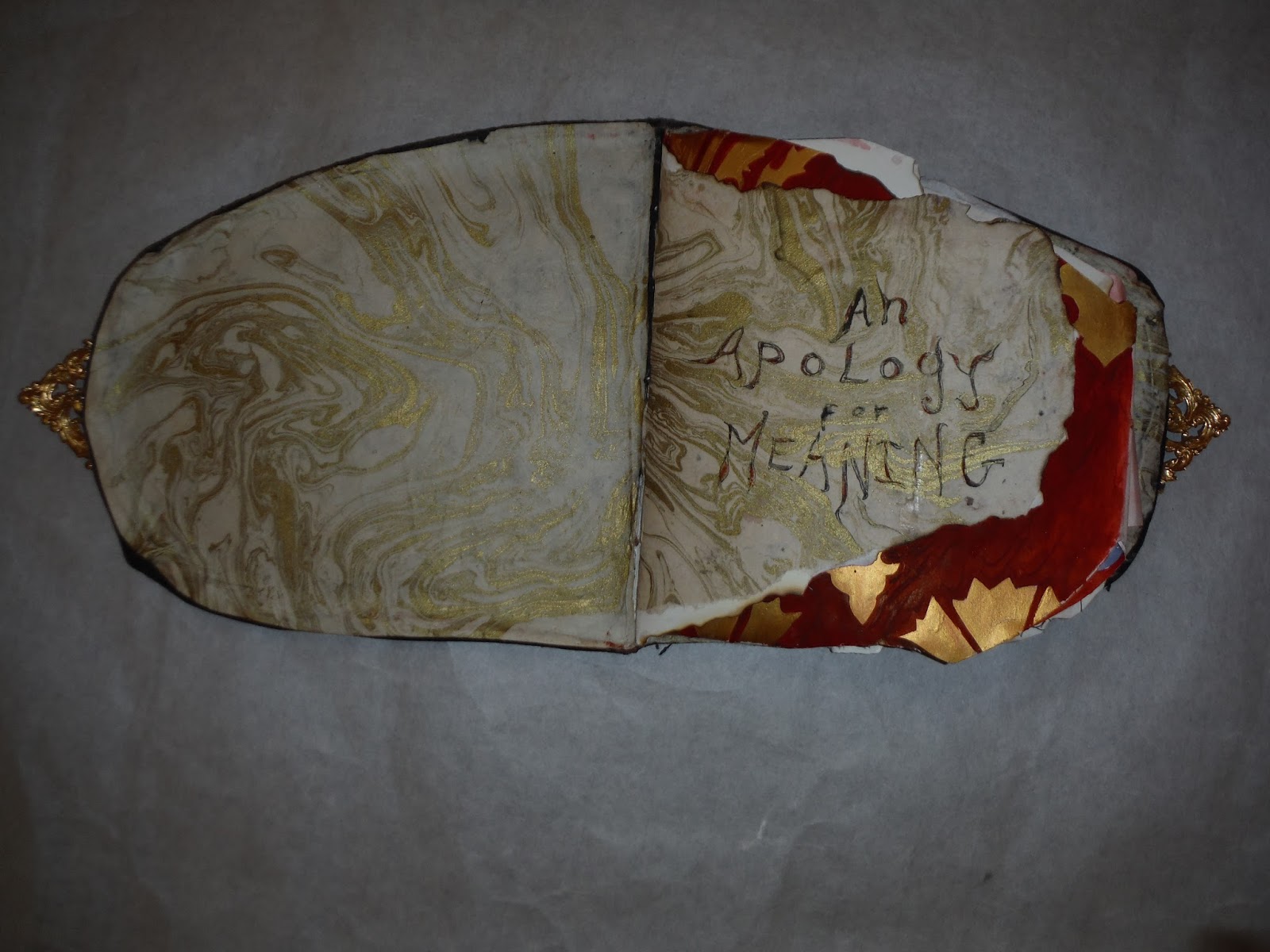
In Torino, Italy, once called Augusta Taurinorum in honor of the bull sacred to Isis, goddess of fertility, where Nietzsche went mad, embracing a beaten horse and weeping, dancing naked in his room, and practicing Dionysian rites of auto-eroticism; where, before his collapse, he enjoyed the air, the piazzas, the cobblestones, and the gelato; where the ladies chose the sweetest grapes for this reluctantly German philosopher, it is easy to feel the sensual, life-affirming, Pagan roots of myth-making, to understand those humanistic allegories that sing of life, love, pleasure, and appetite.  At the opera, I heard Tosca sing, “Vissi d’arte, vissi d’amore” (I lived for art, I lived for love). I indulged in long wine-drenched lunches on unseasonably-sunny piazzas, and gazed at gleaming artifacts from ancient times in dark museums. There was a secret restaurant where a small fierce woman named Brunilde roughly took my order, displayed magical cakes with her wide toothy smile, briskly removed the empty plates that once held the most delicious food I’d ever eaten, brought me a shot glass with grapes soaked in absinthe with dessert if I pleased her by ordering it, but growled me out the door if I was too full or too stupid to partake of her pride and joy. I was in residence at the Fusion Art Gallery on Piazza Amedeo Peyron, presided over by the wise and warm painter, Barbara Fragnogna, who told me about the market across the way which sold beautiful mushrooms, wild strawberries, and bread sticks with huge, juicy olives. When I wasn’t eating, or wandering in museums, I was building an elaborate book which folds and unfolds, and is painted and glued and stitched, and “gold-leafed” with foil wrappers from the many gianduji chocolates I enjoyed. I threw off the layers of the Vermont winter to feel the wind and sun on my body, and was reminded of how much our conclusions about what life means are influenced by the relationship between our own physicality and the material world which surrounds us.
         Meaning is not something that we need to artificially superimpose on the objects and events of the world through some transcendental narrative or morality. It is not something we need to be taught or coerced into seeing by external social construction or manipulative indoctrination. If one is healthy, has an appetite, and senses for seeing, hearing, tasting, and touching, beauty will be everywhere, as “the promise of happiness” or, indeed, in the knowledge of happiness’s fleetingness or absence. We are given the gift of colors and sounds, of textures and of temperatures.  And if all else fails, this should be enough reason to be grateful for life. In addition to this inherent meaning, this meaning without thought and evaluation, our intellectual response to the physical facts of the world makes us dream, imagine, and invent ever new celebrations and laments. These expressions will survive and proliferate insofar as other humans resonate with them.  And what resonates will be made manifest in real made things, in built places, in enacted experiments. This is a discourse and manifestation over millennia, from the ancient cave paintings to today: humans trying to make sense of the terror and tenderness of the world. We do not despair, we artists and “creative subjects”. Nor do we invent meanings that attempt to twist the facts of nature: Gravity and Mortality are real.  Instead, we work with what there is, and endeavor to embrace it in all its fractured glory. Thus, also, the things that we  make with our hands, out of paper, pigments, wax, string, fire, earth, water and air, will fade, crumble, dissolve in good time. They are already fragile, already very imperfect, already mostly forgotten.  And yet, their fleeting presence is of the utmost importance.
I am sitting on a bench in a church entranceway. A gray, cool, dreamy late morning. Some high school students, girls and boys, gather at the other end of the stone courtyard, gossiping, talking, laughing. Old people, alone, walk in and out of the church. It is a Monday, and most shops here are closed, their metal gratings pulled down. Dirty pigeons coo. In the back streets, a gentle squalor; clothing hanging from lines; abandoned bicycles resting against elaborate gates. On the walls, scraps of political agitation, left and right, shreds of old posters, graffiti scrawls. People talk, but I don’t understand. Markets everywhere, with abundance: artichokes and more artichokes, wheels of cheese, sausages, chickens, lamb shanks, lemons. People smoke and joke, are grim or warm. On my walk here I passed a waitress carrying a tray of espresso down the street from a cafĂ© out of sight, and a silver piece of paper blew to the ground. I picked it up and handed it to her. Grazie, Signora. An elegant lady walks up the church steps now, in perfectly matching brown and gold, soft brimmed hat with gold trim, a brown cane, brown coat with fur collar, a purse of gold and brown plaid, little brown shoes, dark sunglasses. All her belongings and all her faith perfectly intact from another era. Trucks rumble by; otherwise it is quiet, peaceful. Balconies preserve foliage from the summer, not quite dead, but not quite blooming, vines dangling; a single bruised yellow rose lilts; while back in Vermont everything is covered in snow and ice. This is a life. Anywhere is a life. How different, how similar is it to and from mine, from or to yours? And how does it happen that it evolved to be like this here and some other way somewhere else?

Sunday, February 7, 2016

An Apology for Meaning


The social constructionists murdered Meaning long ago, but she persists to move us, naĂŻve as we are.  And, lo, we understand each other, more or less, despite cultural crisis and alienation, despite the treachery of concepts and the mis-pris(i)on house of language! They warn us that our every impulse has been constructed randomly out of nothing, or, at best, out of the machinations of the people in power who have managed over centuries to control our minds, our behaviors, our hearts with the deceitful seductions of fairy tales, myths, art, religion, and philosophy.  In  exchange, then, for putting away these beloved artifacts of the “ages of ignorance,” they offer us their scoffing analysis, which uncovers the fact (which sages of all ages already knew) that concepts and words are inaccurate delimitations of the multifarious irreducible variety of reality, and that humans tend to form habits which keep them from re-evaluating their values. That humans can be lazy and conformist, and that words only approximate the things and experiences that they describe, are not good enough reasons to throw over all of the attempts made by our less than lazy fellow humans over the ages to understand and celebrate and lament and re-imagine our shared existence.  Only a theorist lacking in aesthetic sense, lacking in love, in human emotion could deny that human beings speak to each other across time and cultures through stories and symbols that carry meanings, albeit imperfectly understood. That the translation is imprecise is not a good reason to give up on the fraught but difficult  challenge of communication from person to person, language to language, culture to culture, past to present to future. Yes, much of what we believe, much of our behavior, has been socially constructed, but this construction has been and continues to be our own work as humans. Nietzsche called us “creative subjects,” and our role, should we awaken from our “wretched contentment” into agency and joyful wisdom, is to continually co-create new ways of being in the world out of the dirty and living roots of our shared human experience. The artist, as the “creative subject” par excellence, re-vivifies stale images and ossified words, dissolving the fixed relations and drawn boundaries around entities and forging new meaningful connections between materiality and imagination, individual particularity and archetypal abstraction. But we all must participate in this process of backward and forward and eastern and western-seeing, engaging in the concerns and delights of our ancestors and our neighbors and continually considering which still serve us and which would best be re-imagined.  We must take up the iconoclastic axes—not to smash the divine artifacts of the past, but —to chisel new forms out of old mountains.

 Consider a paved path in a city. Sometimes, even though the powers that be have paved a sidewalk and expected the citizens to conform to its guidelines, someone feels that there is a better way to get from here to there, and enough people feel their feet drawn to this alternate way, that the people begin to tread a new path through an area that was intended to be grass. There are desire lines stronger than social constructs, and these desire lines insist on new arrangements of the world even though (or perhaps precisely because) the old ones have been established by asphalt. The new paths, which were once rebellious and eccentric become, in time, established, sanctioned, and limiting, and new people may find that there are better ways to get from here to there.  If language has tendencies to close down against thought, language users also have tendencies to disrupt these patterns. If people in power attempt to coerce and control, less powerful people also have always subverted these attempts. Consider how pilgrims in early Christianity resisted the Church’s injunctions against idol worship and the kissing and fondling of relics. Consider the Copernican revolution, Relativity, &c. No path is made without the desire of some person, without the choice of some person or for some reason (however good or bad). The path may be made because of beauty or utility or for sentimental reasons, for access to a view, because it is private, because there are no obstacles underneath or adjacent to it, because there are special features along the route, or because there are no other options left. But any path will revert to wildness in time if no one walks upon it.

Friday, February 5, 2016

Correspondence and Difference


In the Egyptian Museum in Torino I am astonished by the way the ancient Egyptians had an instinct for symmetry, for placing each depicted object or vignette centrally within a frame, for aligning each hieroglyph in a uniform square of space, for leaving the most graceful and harmonious negative space between the hand of the man holding a slaughtered bird by its neck and the fronds of the plant in a vase by his side. A sense of what is beautiful, evidently, is at least somewhat natural and universal. And the works of art or ritual made with this sense of what is beautiful still resonate with a mysterious significance, even if we today cannot fully understand or believe in the things that were sacred to the people who made them.  Translation across time and cultures is needed for a more approximate comprehension of the objects, but something very powerful, something powerfully familiar is present even without a struggle. What we want is to maintain the strangeness, while approaching a comprehension.  What we must avoid is to diminish difference in the interest of a complete and total correspondence. 

I am operating in a language I barely know, but I do make myself understood, more or less, with the few Italian words I mispronounce and the few I manage to understand.  Sometimes we communicate better with someone who does not speak our language or who lived in another era or lives in another continent than we do with a coeval compatriot. But a good part of the pleasure of communication is in the frisson of partial misunderstanding, in the incommensurable distance between one mind and another struggling to approximate a shared vision. Translation is necessary even without a language barrier, and we all do our best to reveal and conceal our meanings from each other. Yes, conceal also. Indeed, as Steiner explained in After Babel, the differences between languages may be a result of a human need to differentiate a group from another, to keep secrets, to individuate from what may be a basically universal commonality.  There are twin drives to compare and contrast, to find analogies, metaphors, likenesses, and to insist on differences, incompatibilities, untranslatables.  While Steiner acknowledges that much of communication is miscommunication, and that translation appropriates and distorts the original language or meaning, he concludes that the misprision ultimately adds something to the original and that without the admittedly imperfect mechanism of language (which itself is a translation from inner to outer), we would have no culture, no community at all.  Translation or solipsism. Most of the people who deny language its ability to communicate are still talking and writing. They have failed to follow up their assertions with their ultimate conclusions, and have therefore led us astray. The same can be said about the way we are told we should operate when it comes to differences and correspondences. We are to ignore differences and deny correspondences. Leaving us precisely where?

Today our basic assumptions about correspondence and difference are paradoxical. On the one hand, we insist that everyone is equal, the same, indistinguishable (or that they should be, were we to look beyond superficial and erroneous external, physical differences). On the other hand, we insist that it is impossible to understand the other, that there are no universals and there is no shared sense of value, and that language barely helps us to communicate with each other since it is so very distant from the things it claims to signify as to be actually treacherous.  Both of these assumptions depend on a denial of the reality or the importance of the physical world, on a denial of any meaningful relationship between nature and cultural norms, between the physical world and the language that describes it, the human brain and its sensory apparatus, and, finally, between one human brain and another.  At once we are trying to strip away differences that might cause conflict, justify hierarchies or discriminations (resulting in a neutering and neutralizing homogeneity) and to deny that these  newly neutralized beings will be able to understand each other despite the pervasive removal of the characteristics that seem to have caused all the trouble in the first place. Perhaps the unspoken hope is that the neutralization and leveling, the moral rejection of the physical world (beauty, ugliness, pain, pleasure, differences) will eventually really result in a homogeneity so complete that, even if we no longer have anything interesting to say or any unique artistic expressions to make, we will at least make no more war, at least harbor no resentment or hate against the “other” anymore—because there will be no more other. And no differential qualities whatsoever to get in the way of perfect passive niceness.

Thursday, January 21, 2016

Pareidolia, Seeing Patterns, Making Meaning

Ernst Haeckel, Kunstformen der Natur (art forms of nature)
On one level, seeing shapes and patterns where they are not "really"  there may be called pareidolia, most often ridiculed as a psychosis that sees Madonna and Jesus faces in rock formations and baked goods. But all of our seeing is a process of selecting out and processing that to some extent belies the fact that reality is a mass of non delineated color and light, a mass of shifting  molecules temporarily huddled into seemingly distinct shapes and beings. We can question whether the things we see are really rightly to be delineated as separate or if our particular arrangements of what belongs with what or who with whom are full contextualizations or merely (socially) constructed biases or limitations.

We can say the same thing about language and the concepts that it forms. Many argue that words are a crime against the multifarious differentiation of reality. That they name and delimit what is really irreducible and unnameable. Names and words and categories pull some things together with other things, leaving other things out, and ignore the qualities of the named and categorized things that do not fit in with the given names--qualities that might better fit these things to be named and arranged in different categories altogether. Is the creation of a concept thus a form of pareidolia?

When we note a pattern, say of bird of insect movement, of repeating forms in nature, in fairy tales, or of habitual actions in our own lives, are we ignoring all of the elements that would render the categorized thing, action, or thought unfitting to be classed within the pattern-concept-arrangement? Or is there really a way to establish that something is enough like something else to establish that it is a pattern and thereby attempt to draw meaning from it?

And there is the crisis point: because we want to draw meaning. And we draw meaning from things that repeat, from something that seems to be universal or at least not a mere exclusive random aberration. It might be absolutely accurate to say that everything is everything and thereby all patterns and all names and all conceptualizations are inaccurate and limiting, that the only accurate vision of reality is of a moving mass of colors and light without delineation or individuation.

 Babies start by seeing that way, but over time begin to recognize shapes, distance, faces. Carl Sagan writes that pareidolia itself might be an evolutionary adaptation, since those babies who were able to recognize faces would respond to the faces, smiling, and making eye contact, and thus were cared for and thus survived. This is pretty suggestive, because if we were to consciously try as a culture to repress conceptualization, arrangement, and the meaning making that rests on this patterning process, we would end up being unable to communicate with each other, and we would not only not survive, but we would not be we. Interestingly, autistic children have a hard time making the kind of eye contact that Sagan suggests was good for survival (probably not because they do not recognize faces though).

 Many say we are now becoming a culture of autism, one in which people do not communicate, one in which people are trapped in their own worlds without the ability to share experience, emotion, ideas. Thus, although the process of making arrangements and making concepts does perforce leave things out, although it is always going to be inaccurate, although it may look like psychosis or pareidolia, it seems far better to me to make provisional arrangements and to use language and concepts (while all the while acknowledging that their meanings can be fluid, changing, rearranged) than to exist in an undifferentiated sea of colors and non-shapes of non-delineated and non-communicated non-ideas.

 Metaphor is the temporary union of two things that are not strictly the same, but similar enough that their comparison brings, as Robert Musil wrote, "beauty and excitement into the world". Making meaning is a matter of seeing patterns and making metaphors. These patterns and metaphors are fruitful and have longevity (in the sense of Dawkins's memes--see below) if they reverberate with other humans, suggesting a real shared meaning (not just a random socially constructed one). Let us continue to see patterns and relations, to make provisional arrangements. Let us continue to make meanings.

Wednesday, November 25, 2015

The Selfish Gene and The Fertile Meme

Chromosomes
I just finished reading Richard Dawkins's famous book, The Selfish Gene, and my mind is reeling. This is no cold, wonderless mechanistic description of life, but a  collection of some of the most astonishing stories known to humankind. Truth (in the form of science), as has many times been noted, is stranger than fiction. One of the more mind-expanding ideas Dawkins explores in this book is the question of why, in the first place, replicators (genes) have come to cluster into bodies (survival machines) at all. Why did they not simply float in the primordial soup and fend for themselves in the great choreography of survival-replication? In an attempt to answer this basic question with which he begins and ends the book, "Why are People?", Dawkins also explores the question of "What are People," i.e., to what extent does it even make sense to see ourselves as discrete complete separate organisms. A body (plant, animal, human) is, in Dawkin's view, basically a vehicle for the many genes which cooperatively cluster together in their own interest (which consists in making it out of the body on the bottleneck of egg or sperm so that they can each reproduce themselves). The body, which thinks of itself as a solid entity of sorts, is made up of many different organisms which cluster together, each only interested in the body's health and well being insofar as it enables reproduction. He even suggests that what is now a complete system of a body may at one time have been a parasite (or many parasites) interacting for mutual benefit within the survival machine. Parasite and host unite over time and become one. Viruses, apparently, are rogue chromosomes splitting off from inside bodies and traveling on coughs and sneezes to infest other bodies and hopefully make a home and nest therein. A stranger's cough is a gene's attempt to invade your body and eventually become one with your other genes, your phenotype. The world around us, not just other bodies, is also part of what Dawkins calls the extended phenotype. Not only the natural essences of bodies, like snail shells or hair, but also things that our bodies make, like beaver dams and, possibly, though he doesn't say this, art. There is, in a sense, no separation between body and body, body and world, except at the individual cellular level. Every living replicator is interacting with other replicators and with the changing environment in really complex ways to respond to and create ideal situations, or Evolutionary Stable Strategy (ESS), for generation. That the gene is selfish, i.e, wants its own reproduction above all else, need not mean that its vehicle is selfish, especially when it comes to humans who have, Dawkins notes, the ability of conscious foresight and of overruling the interests of the gene and natural selection (consider both birth control and the welfare state, the latter ensuring that the gene for having more children than can be cared for is unnaturally allowed to survive and proliferate).  While it is distinctly not natural and has, he notes, never been done, there is no reason why humans could not choose to create an entirely altruistic society. The meme, a word coined by Dawkins, is the replicator that takes over the gene's role when it comes to society and culture. It too is a replicator and it too ensures its survival unconsciously through proliferation in survival machines which themselves do not replicate but only carry genes and memes. Are memes the same as social constructs? What does it take for a meme to survive? According to Dawkins, the proliferating meme needs to have the same qualities that a proliferating gene has: longevity, fecundity, copying fidelity (they don't get changed too much over time). Some memes, like celibacy or self-sacrifice for one's country, work against the interest of genes. Some, like blind faith, or God, seem to provide no apparent biological advantage (though some of Dawkins's colleagues disagree with him on this). The meme need not be in harmony with natural facts, but it probably does serve some human need (Dawkins gives the example of the belief in afterlife, which comes naturally out of a human fear of death and the unknown). The ones that catch on, that are fecund, long-lasting, and have copying fidelity, do so for a combination of reasons including human psychology, the particular social and natural environment at the time, the other competing memes in the meme pool. Genes too interact with their environments in the attempt to reduplicate and survive (which reminds us of the nature/nurture debate), and, as such, we can see that while what is genetic is extremely influential upon who we are, the benefits or drawbacks of particular gene-characteristics depend to a large degree on the particular social contexts that the survival machines housing the genes live in. We (or shall I say, the individual genes which have clustered inside of and built their vehicles, which we call our bodies and conscious minds) have come a long way from the primordial soup. Our ideas about the world, and the meanings we ascribe to it, are determined by many different factors, biological, social, environmental, by chance. And just how the interaction functions (between what is determined and what is determinable, between what we are and what we could be, between mechanistic pre-programming and choice and creation and possibility) is one of the most exciting unanswered questions of life.

Tuesday, September 29, 2015

Reality, Evidence, Language, Social Construction, Darwin

I have been thinking and reading lately a good deal about the social construct of the social construct and trying to parse out what of our perceived reality is more or less repeatable, verifiable, universally experienced, and what is more or less constructed by individual and group abstraction, personal or social narratives, conscious or unconscious leaving out or foregrounding. The ubiquitous phrase, "that's just a social construct" has become a sort of a joke around the house as we tell someone who has stubbed her toe or who has a headache or who thinks she is in love or who believes she has succeeded that her perception is little more than a delusion brought on by her own or more probably her society's way of framing and describing reality. The assumption is that her pain, her pleasure, her ideas of success could just as easily be different feelings or be inspired by utterly different causes if only....The assumption is that our ways of looking at the world are randomly constructed (that they have been randomly constructed at some time in the past by some people who constructed them for no particular reasons or perhaps in order to benefit themselves and make others suffer). This concept is, of course, grounded in the philosophical realization that it is impossible to experience, see, know " the thing in itself". We see only phenomena and not realities, and our seeing is determined by filters or structures in our brains that direct the ways in which we see. This realization has been transformed, however, to mean that what we see is necessarily either wrong or extremely different from what is, an assumption that was not present in Kant's analysis. The Modernist appropriation of Kant also exaggerated the differences between what one brain and another is likely to see. While Kant did note that each person sees a different shade of red, he did not suggest that we each see entirely different colors, or that colors themselves did not exist. While our seeing is determined by all sorts of things, both biological and experiential, there is no reason to assume that two human brains will necessarily see something radically differently all the time.
     Nietzsche, inaugurating the "linguistic turn," made us aware of the way language conceptualizes reality by creating names or descriptions of things (terms) that leave out as much as they contain. Words are inexact figures and metaphors, inaccurate and incommensurate attempts to describe reality. We group similar things that nevertheless exhibit many differences under categories; and this process induces a sort of simplification of seeing. We come to see dogs, trees, men, women, instead of individual creatures and entities. This eventually leads us to create concepts and reifications, such as love, good, bad, noble, moral, money, which are more and more removed from physical reality and experience. While many theorists after Nietzsche came to see this use of language as a treacherous crime committed by language upon reality, he tended to see it in a more creatively joyous light: just as long as we do not come to be the slaves of ossified constructs and concepts, just as long as the  "creative subject" continues to make new terms, new words, new metaphors, new figures to describe a changing reality from his own shifting perspective, just as long as individuals stoke the flame of a living language, language can be a prod and a stimulus to new seeing.
     Social construction theory has tried to moralistically discredit this joyous aesthetic and existential world- and word-making  activity and replaced it with an imperative to strip every word and every concept of its given meaning by calling all designations and conceptualizations into question. This leaves us with strictly nothing but experience itself, unsung, unquestioned, unnamed. They would discredit myth, historic narrative, fairy tales, religious legends, songs, poems, paintings, totems, talismans as random and treacherous social constructions. They would have us scoff at any product of the human imagination as a product with some abstract non-human author, as something necessarily imposed upon from some force that would have to be extra-terrestrial, not ouselves, not natural. They would insist that a human is not capable of experiencing his or her reality without being blind-sided by the already constructed way of seeing determined in his or her society. Of course our visions and perspectives are colored by our social context and these visions do vary from one culture to another, often extremely; but these variations do not come randomly out of nowhere. The variations between cultures must be the product of many different influences, from climate to landscape to the requirement for survival of a particular place and a particular people. Originary group social experiences are passed down from generation to generation, and are altered or not over time. Certainly old customs can be kept longer than necessary and humans on the whole may act according to originary evolutionary necessities that are no longer useful and even sometimes harmful in our current context. But these ways of seeing and ways of acting are not random. In other words, while there certainly are many social constructs, there is no such thing as "just" a social construct (a phrase that suggests that the construct has appeared out of nowhere and that it has no validity whatsoever). Social constructs, including language, are the product of human interaction with nature, the physical world, social groups, experience. They must always be questioned and often must be challenged, and each creative subject has the power and responsibility to create new ones which must interact with those created by others. Influence, interaction, discourse, criticism, the scientific method, testing of assumptions, positing of hypotheses and theories, gathering of facts and evidence to support the hypotheses and theories, foregrounding certain facts over others, selecting out and focusing on one or another aspect, evaluating based on differing values and differing relative needs of the moment. While many things may be true and verifiable, everything is not. Anything does not go, though many things might.
    I have been reading a biography of Darwin (The Survival of Charles Darwin by Ronald Clark) and thinking about these questions within the context of evolution. Is evolution a social consruct? No better than the one it replaced? Darwin's critics accused him of gathering data to support his hypothesis, as if such a process was manipulative and dishonest. Clark writes:  "Darwin himself had written years earlier in the third of his 'Species' notebooks: 'The line of argument often pursued throughout my theory is to establish a point as a probability by induction & to apply it as hypotheses to other points & see whether it will solve them.' And after publication of The Origin, he commented: 'How odd it is that anyone should not see that all observation must be for or against some view if it is to be of any service!'"(140). In the twenty years of gathering and testing evidence from the natural world leading up to his writing of The Origin of Species, Darwin actually worked from observation toward hypothesis in a remarkably innocent way, not expecting to find (to borrow Nietzsche's wonderful image in "On Truth and Lying in a Supramoral Sense") the truth he had himself hidden behind a bush. He actually discovered data that disproved the socially constructed truth of his society, proving that individuals are not such dupes as social construction theory makes us out to be. We are capable of overturning the constructions created by our predecessors, challenging, criticizing, or revising the constructs and narratives of other humans throughout time and across space, following errors to new truths or old truths to new errors. We can continue to do this, or we can decide, with the social constructionist theorists and their deconstructionist progeny that no way in which anyone has ever described the world, no poem, no theory, no evaluation or re-evaluation of values is reality-relevant (except of course the social construction of social construction theory or deconstructionist skepticism), that language is a crime against nature, and the history of ideas and the idealistic pursuit of education is an Enlightenment plot to impose random (or are they actually based on the preferences of the people in power, which then, would actually be natural and thus not a construction?) ideas of good and bad on a beknighted populace? We can just do away with our libraries and our picture galleries, our approximate meanings and our attempts to understand what cannot ever be completely mastered, our mythologies and our delightful misprisions, and smugly, certainly, moralistically and accurately, resort to grunting and sneezing. No misleading words, no oppressive influences, no images to teach us that one thing or person is more beautiful or more valuable than another, no theories, no ideas at all, only an honest gaping silent void.